
Lozier Shelf Load Capacity Guide
Overloading a gondola shelf is one of the fastest ways to warp a fixture, damage merchandise, and create a liability exposure on the sales floor. The Lozier catalog publishes uniform load ratings for every shelf, deck, and structural component, and those numbers are the correct reference for planning a fixture that holds what you intend to sell on it. This guide compiles the ratings that matter most, translated into plain English with the reduction rules that catch buyers off guard.
All figures below come directly from the Lozier catalog. Numbers assume the load is evenly distributed across the full width of the shelf or deck. Front-loaded or short-width installations must be derated per the notes at the end of this page.
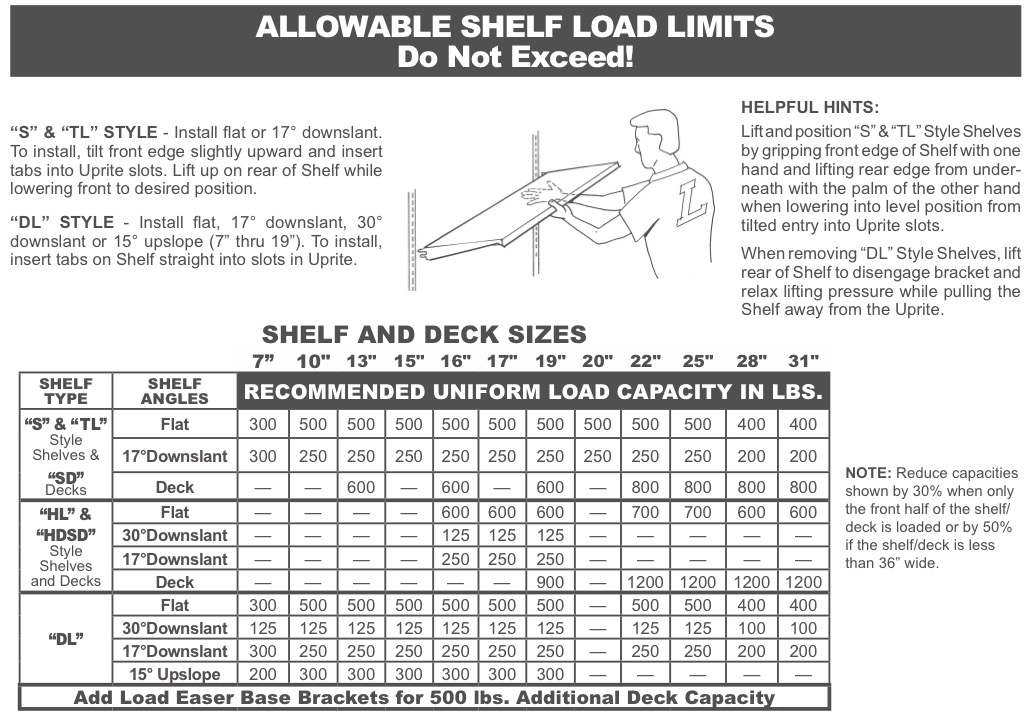
Allowable Shelf Load Limits by Type and Depth (lbs)
Uniform load capacity per shelf, in pounds, at flat and angled positions.
| Shelf Type | Angle | 7″ | 10″ | 13″ | 15″ | 16″ | 17″ | 19″ | 20″ | 22″ | 25″ | 28″ | 31″ |
|---|---|---|---|---|---|---|---|---|---|---|---|---|---|
| S & TL Shelves & SD Decks | Flat | 300 | 500 | 500 | 500 | 500 | 500 | 500 | 500 | 500 | 500 | 400 | 400 |
| 17° Downslant | 300 | 250 | 250 | 250 | 250 | 250 | 250 | 250 | 250 | 250 | 200 | 200 | |
| SD Decks (deck rating) | Deck | n/a | n/a | 600 | n/a | 600 | n/a | 600 | n/a | 800 | 800 | 800 | 800 |
| HL & HDSD Shelves and Decks | Flat | n/a | n/a | n/a | n/a | 600 | 600 | 600 | n/a | 700 | 700 | 600 | 600 |
| 30° Downslant | n/a | n/a | n/a | n/a | 125 | 125 | 125 | n/a | n/a | n/a | n/a | n/a | |
| 17° Downslant | n/a | n/a | n/a | n/a | 250 | 250 | 250 | n/a | n/a | n/a | n/a | n/a | |
| HDSD Decks (deck rating) | Deck | n/a | n/a | n/a | n/a | n/a | n/a | 900 | n/a | 1200 | 1200 | 1200 | 1200 |
| DL Shelves | Flat | 300 | 500 | 500 | 500 | 500 | 500 | 500 | n/a | 500 | 500 | 400 | 400 |
| 30° Downslant | 125 | 125 | 125 | 125 | 125 | 125 | 125 | n/a | 125 | 125 | 100 | 100 | |
| 17° Downslant | 300 | 250 | 250 | 250 | 250 | 250 | 250 | n/a | 250 | 250 | 200 | 200 | |
| 15° Upslope (7″ to 19″) | 200 | 300 | 300 | 300 | 300 | 300 | 300 | n/a | n/a | n/a | n/a | n/a |
Source: Lozier catalog, Allowable Shelf Load Limits chart. Numbers listed as ″ are inches of shelf depth.
Two derating rules that apply to every row in the table
- Reduce capacity by 30% when only the front half of the shelf or deck is loaded.
- Reduce capacity by 50% if the shelf or deck is less than 36″ wide.
Both reductions are cumulative when both conditions apply. A 24″-wide shelf loaded only on the front half of an 800 lb catalog rating carries less than 300 lbs in practice.
Shelf Types, Plain English
- S and TL Style are the standard tag-molding shelves used on the vast majority of retail gondolas. Tabs slide into the upright slots after tilting the front edge up.
- SD (Standard Deck) is the base deck that sits at the bottom of the section, resting on base brackets. Deck ratings are higher than shelf ratings because the deck is supported by the base brackets, not cantilevered off the upright.
- HL (Heavy Load) and HDSD (Heavy Duty SD) use a taller bracket profile. Per catalog, HL raises capacity 40% versus S/TL, and HDSD raises capacity 50% versus SD. Use for hardware, beverage, and dense-SKU categories.
- DL (Double Locking) installs by inserting tabs straight into upright slots and locks front and rear, allowing 30° downslant, 17° downslant, and 15° upslope positions in addition to flat.
Base Deck and Base Bracket Capacity
The base deck rating in the chart above assumes standard base brackets. Two upgrades change the number:
- Standard SD deck on Standard Base Brackets: 600 lbs evenly distributed at 13″ to 19″ depth, 800 lbs at 22″ to 31″ depth. Adding Load Easer Base Brackets increases capacity to 1,100 lbs and 1,300 lbs respectively.
- Load Easer Base Bracket adds 500 lbs additional deck capacity when placed halfway between standard base brackets. Straight or angled orientation depending on deck depth. Works with all Lozier deck depths.
- HDSD (Heavy Duty SD) deck holds 50% higher load capacity than an SD deck at the same depth.
Upright Capacity
- Standard Uprite is the default gondola upright and supports the shelf capacities listed above at the catalog-listed heights.
- Heavy Duty Uprite is a heavier-gauge column recommended when total shelf loading exceeds standard uprite capacity or when using HL/HDSD components throughout the section.
- High Capacity Uprite (UHC) is two HD uprites welded back to back with welded HD base brackets. Rated at 35,000 in-lbs unbalanced load capacity. Available in 06 base height only, 78″/84″/90″/96″ heights, 22″/25″/28″/31″ depths. Use for beverage or other heavy, dense merchandise.
- Telescopic Uprite System (TEL30): 200 lbs per side, per section, regardless of shelf count. Reduced to 60 lbs per section when installed on a wall section with backs on one side only.
Wire, Glass, and Specialty Shelf Capacity
- Wire Shelf: evenly distributed load of 500 lbs.
- Reversible Wire Shelf (RBS): 150 lbs in flat position.
- Wire Grid (WG): 50 lbs in flat position.
- Glass Shelf Assembly (GSA): 125 lbs.
- Feature Shelf (FS): 75 lbs.
- Wood Insert Shelf: hanging full width or full depth, 25 lbs; total on shelf, 175 lbs.
- Wedgr / Contoured End Shelf: evenly distributed load of 300 lbs in flat position. Reduce by 50% at 17° downslope; reduce by 30% when front loaded.
How to Pick the Right Rating for Your Category
Most retail categories fit inside standard S/TL and SD ratings. The categories that push into HL, HDSD, Load Easer, or High Capacity territory tend to share three properties: dense merchandise (glass, metal, liquid), deep facings (multiple SKUs stacked front to back), and full-height sections (five or six shelves loaded).
- Beverage (soft drink cases, beer, water): HL shelves and HDSD decks, often with a High Capacity Uprite on end sections.
- Hardware and automotive: HL shelves; Load Easer on the base deck when merchandising batteries, fluids, or bulk hardware.
- Grocery center store: standard S/TL shelves with SD decks handle canned goods, boxed goods, and most packaged foods within rating.
- Pharmacy, beauty, health & beauty: standard S/TL shelves are sized well beyond typical merchandise weight; specify shelf depth for facing count, not capacity.
- C-store beer cave: HL shelves and HDSD decks; if the section is a deep double-back beverage run, plan the upright as High Capacity.
Common Mistakes That Void the Ratings
- Front-loading heavy SKUs and leaving the back empty. This is the derate that catches remodel teams off guard. A shelf rated 600 lbs holds 420 lbs when the front half carries the load.
- Cutting or drilling shelves. Any modification voids the rating.
- Mixing shelf types on the same upright without checking the upright. Standard uprights handle standard shelf ratings. Systematically upgrading shelves to HL without upgrading uprights can exceed column capacity.
- Using standard base brackets under a heavy deck load. When approaching the 1,100 to 1,300 lb SD deck rating, add Load Easer brackets rather than assuming the deck alone is the limit.
- Assuming end caps carry the same rating as inline shelves. End cap capacities are lower and should be planned separately per the catalog rating for that specific end-cap style.
Need help planning a section that holds what you're selling?
Related: For notch spacing, upright height ladders, base height math, and section width rules that determine where a rated shelf actually sits, see the Lozier Upright Notch and Shelf Height Reference.
Send us the merchandise category and section dimensions. We'll spec the right shelf type, deck, base bracket, and upright rating from the Lozier catalog, and confirm the derating math before you order. Call (800) 934-6798 or use the 3D Gondola Builder to draft a section and request review.